Supporting evidence. Where it matters.
Where appropriate, we arrange laboratory analysis for mould, mycotoxins and other environmental contaminants.
INDOOR AIR QUALITY TESTING
Lab results should answer questions, not create them.
We use laboratory analysis to investigate mould, bacteria and other environmental contaminants. Testing may be selected to support the wider investigation or undertaken in response to a specific client request, such as confirming the presence of mould or identifying particular mould species.
TESTING IN CONTEXT
A lab result is only one piece of the investigation.
Mould does not grow simply because spores are present. Spores are a normal part of our environment and can enter buildings through open doors and windows, on clothing and through normal occupancy.
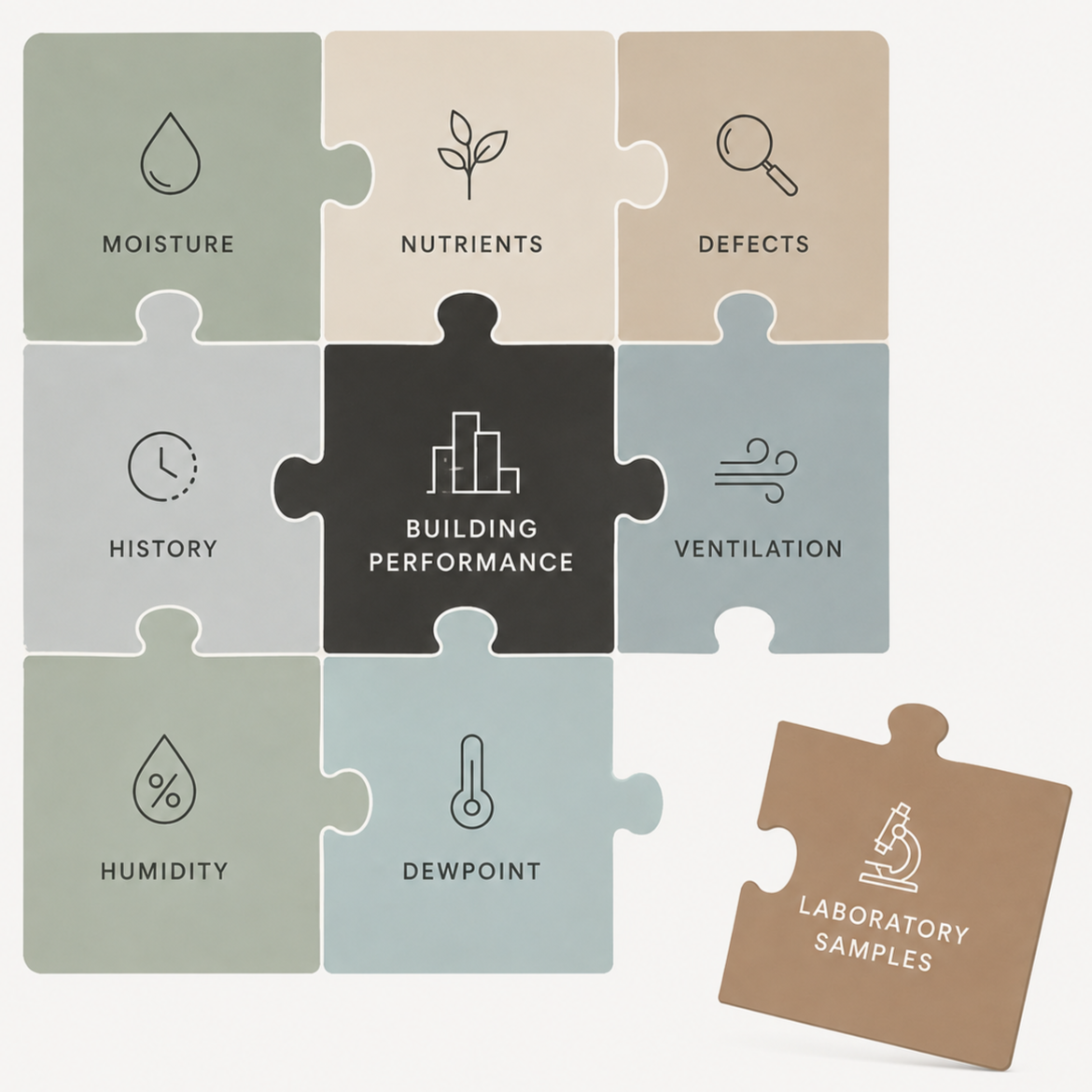
For mould growth to develop, the conditions also need to be right. Moisture is the critical factor, while suitable temperatures and organic materials such as dust, timber, paper-faced plasterboard and other building materials can provide potential food sources.
That is why laboratory testing is most useful when considered alongside what is happening within the building. Moisture behaviour, ventilation, condensation, water damage, building defects and the history of the property all help give meaning to a laboratory result.

REQUESTED BY YOU
Testing for a specific purpose.
Laboratory testing may also be requested for a particular reason. A client may want to establish whether mould is present, identify the mould species within their property, or investigate whether particular species identified through clinical testing are also detectable within their indoor environment.
Where testing relates to health concerns or clinical results, our role remains focused on the building and indoor environment.
Environmental testing can identify what is detected within the property, but interpretation of blood, urine or other clinical testing remains with the appropriate medical practitioner..
WHAT ARE WE TRYING TO FIND OUT?
Different Questions. Different Tests.
There is no single mould test that provides every answer. Different sampling methods examine different parts of the indoor environment and provide different types of information.

Air Samling
Air samples provide a snapshot of what was airborne at the time of sampling. They can identify and quantify mould structures within the sampled air and allow comparison between different areas and, where appropriate, the outdoor environment. However, airborne concentrations can change considerably with activity, ventilation and environmental conditions.

Surface Sampling
Tape lifts and swabs can help investigate visible or suspected growth on a particular material or surface. These are targeted samples and answer a different question from either air or dust testing. Surface sampling can help identify the types of mould present and provide supporting evidence where the nature of visible staining or growth is uncertain.

Dust Sampling
Settled dust accumulates material over time and can therefore provide a different perspective on the indoor environment. DNA-based analysis can identify individual mould species present within the sample, including species associated with water-damaged buildings. Dust results do not, however, tell us precisely where mould is growing or whether a building defect is currently active.

GENUS OR SPECIES?
The level of identification depends on the test.
Some microscopy-based tests identify mould primarily to genus or group level. For example, Aspergillus and Penicillium spores can be difficult to distinguish reliably from one another using routine non-viable microscopy and may therefore be reported together.
DNA-based methods can identify and quantify individual mould species, providing much greater specificity about what has been detected within a sample.
Neither approach is automatically "better". They answer different questions, which is why the sampling method should be selected according to what the investigation is trying to establish.

ARE YOU
Ready for the evidence?
Whether you're concerned about mould, moisture or indoor environmental performance, every investigation is designed to provide the clarity needed for informed decisions.
✓ Investigations available throughout the UK and selected parts of Europe.
✓ Flexible payment plans available on request.
Trusted by Profressionals
-
![Smiling middle-aged man with short gray hair, wearing a gray shirt and a plaid tie, standing indoors with a blurred background.]()
Bill Weber - Principle Consultant at Avelar, Active Member of ISEAI and CIRSx and a Board-Certified Indoor Environmental Consultant (CIEC), ACAC.
“I have complete trust in Sam Bellemy and the team at Mould Focus. Sam is highly knowledgeable about mould and moisture surveys, and his approach is always thorough and detailed. He takes the time to explain everything clearly and ensures nothing is overlooked. Whenever I have the opportunity to refer someone - whether in the UK or anywhere across Europe - I confidently recommend Mould Focus. They are true professionals who deliver reliable, high-quality service.”
-
![Woman taking selfie at conference or seminar with audience in the background, large windows, and presentation screen.]()
Lisa Malyons - Founder UK Centre for Mould Standards.
"As a mould-illness survivor and the founder of the UK Centre for Mould Safety, I found it hard to find people I could trust. Sam was recommended to me by a healthcare professional and I never looked back. His surveying skills are excellent as presented in his reports and his mould health knowledge is a head and shoulders above many others who claim to know about mould. Sam is a pleasure to work with and I have recommended him many times since".
-
![Person wearing full protective gear, including a white suit, face shield, and respirator, standing in a room with unfinished wooden shelves and a window.]()
Sarri Itani - Aiden’s Mould Removal
"We regularly receive inspection reports completed by Sam at Mould Focus, and we have always found them clear, thorough and easy to work from when preparing a mould remediation plan. His reports provide the level of detail needed to understand the issues within the property and plan the correct remedial works. We have also found Sam very easy to liaise with while we are on site, particularly when we need clarification or further information regarding his findings. Sam is extremely knowledgeable, professional and clearly understands both mould investigation and the practical requirements of remediation. We would be very happy to recommend Mould Focus".
-
![A smiling middle-aged man with short gray hair, wearing a gray T-shirt, standing outdoors with trees in the background.]()
Anton Krige - Best You Functionable Health Clinic
"Great service from Sam. Provided an assessment appropriate to the property and a pragmatic action plan. He was able to convert dense inspection information into a concise, practical plan & he was extremely personable during the inspection. Highly recommended! Went out of his way to help us"
-
![A young man with glasses, curly hair, and a headlamp working in an attic space with exposed insulation, ductwork, and wooden beams.]()
Aaron West - Founder of Sussex Heritage & Damp Restoration, and Elements.
I've known Sam for many years through the property industry and, as someone who has spent my career specialising in Damp Engineering, I can honestly say he is one of the most trustworthy and genuine mould experts you'll meet. His knowledge is exceptional, but what impresses me most is the way he approaches people. Sam has a good heart, a strong moral compass and always wants to do the right thing. He gives honest advice, never overcomplicates things and genuinely cares about getting the best outcome for his clients. That combination of expertise, integrity and compassion is incredibly rare. If Sam tells you something, you can trust it. I recommend him without hesitation".
-
![Logo reading "SKYS" in large blue stylized letters with an abstract geometric design in the center.]()
Carl Reid - Swift Maintenance Solutions
"Happy to say Sam is fantastic to work with. We are mould literate builders and damp surveyors so when we get any clients looking for a specialist mould surveyor we are very happy to recommend Sam ( mould focus). His reports are detailed and very precise so when following his recommendations it makes a mould remediation job so much easier. We will continue to work closely with Sam as it is very hard to find someone so knowledgeable in an industry now saturated with companies that just do not come anywhere near his ability".
-
![A man with short dark hair, a full beard, and smiling. He's wearing a white shirt and a black blazer, standing against a light-colored wall.]()
Jay Devram - Founder of Lightwork Home Health.
"Sam is a knowledgeable and professional mould inspector who takes great care of the people referred to him. I’m always confident recommending him to anyone who needs a thorough mould inspection".